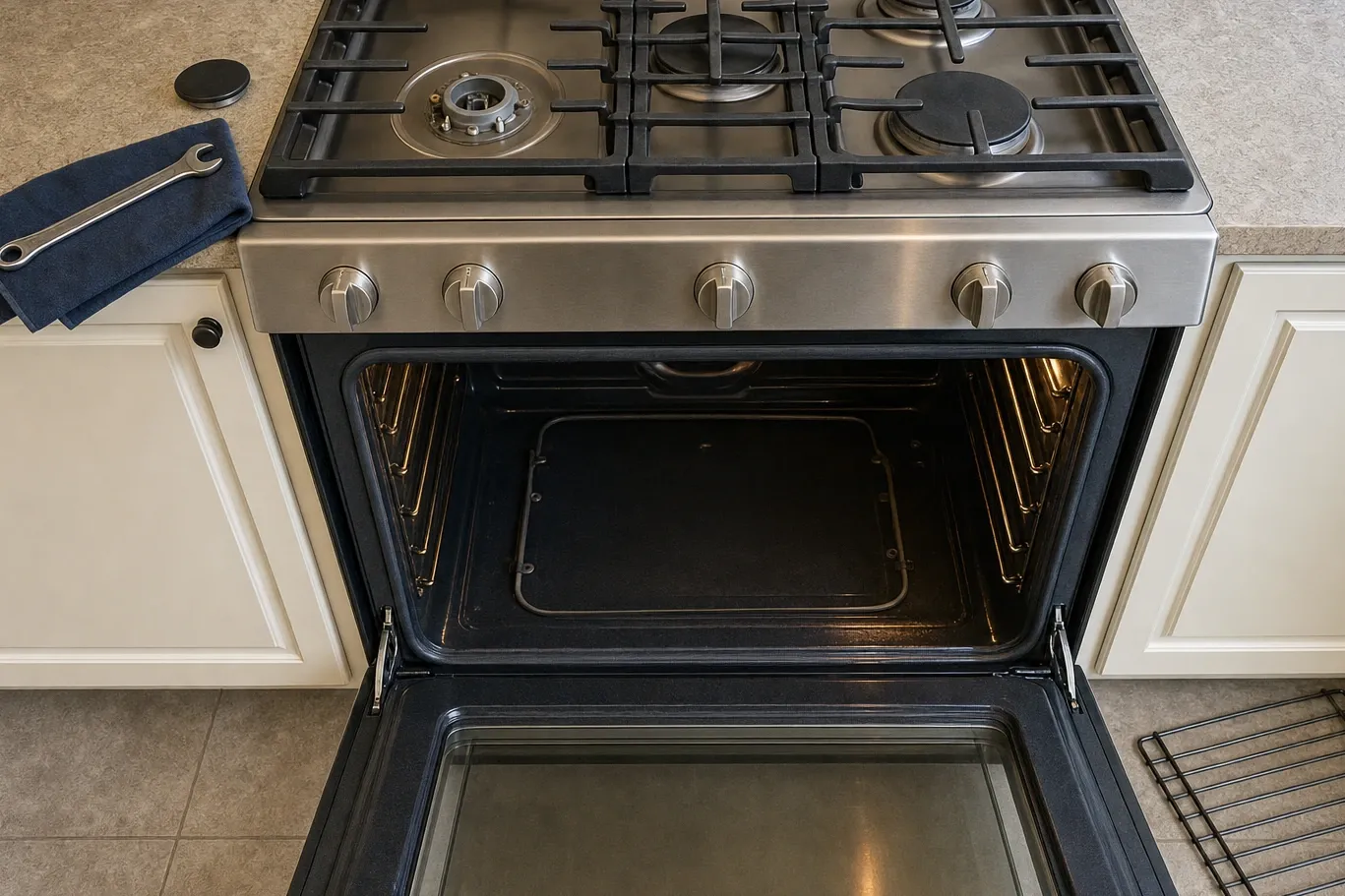
Why a Wolf Simmer Runs Too Hot in a Denver Kitchen
A Wolf burner that will not sit low enough to hold a sauce is usually set up for sea level rather than for a mile of elevation. How to tell a set-up fault from a failed part before anybody orders one.
Written by Desmond Achebe Cooking-appliance technician — controls and fault codes · 11 years in the trade
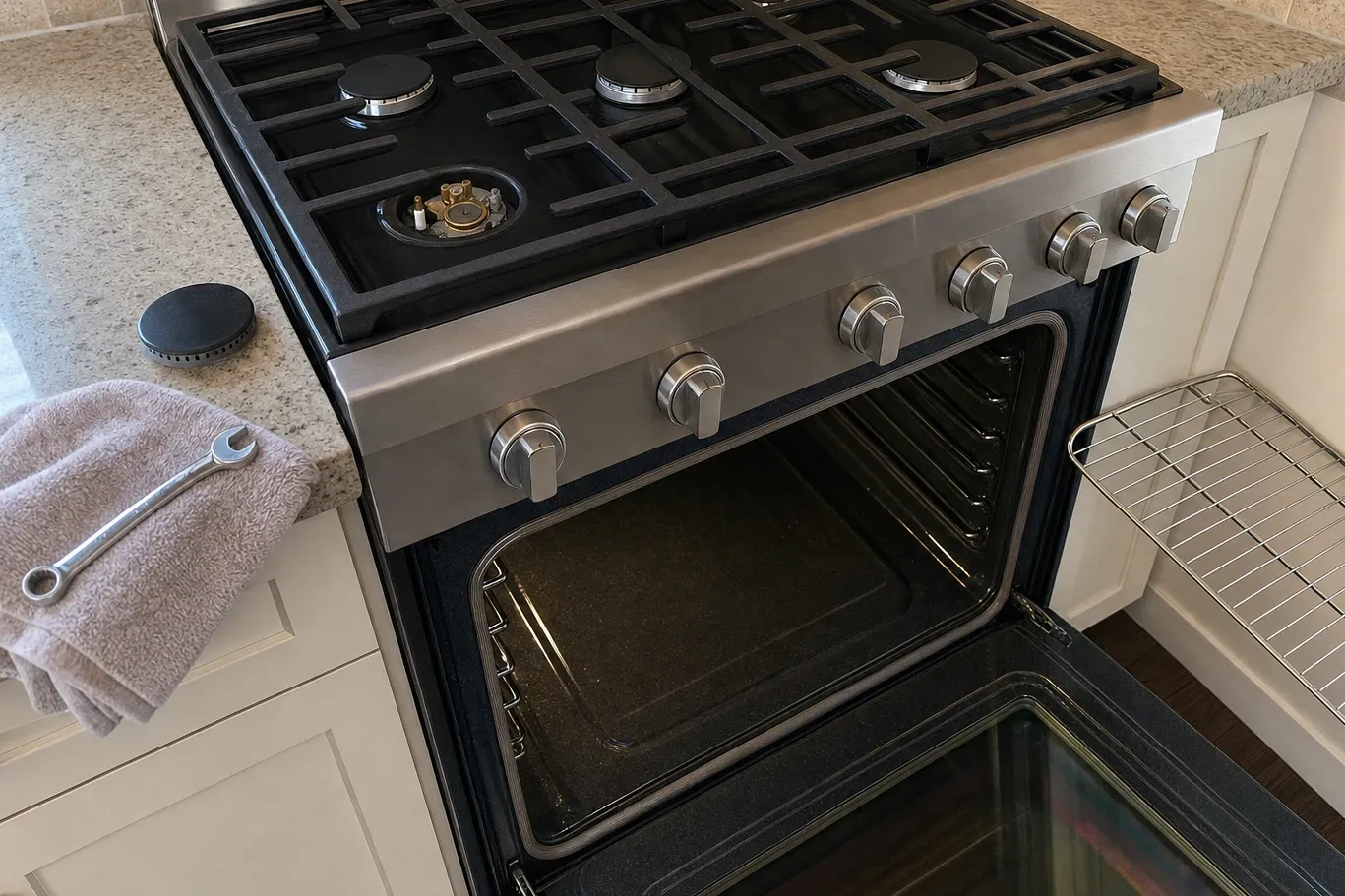
Everybody who moves to Denver with a serious range hits some version of this. The burners light, the oven works, the hood pulls, and yet a sauce that used to hold at the lowest setting now catches and scorches within ten minutes. Chocolate seizes. Rice sticks. The instinct is to blame the valve, and the valve is almost never the problem.
What has usually happened is simpler and much cheaper to put right: the burner is still set up for the air it was tested in, and the air in this city is not that air.
What “too hot to simmer” actually means
A gas burner has two separate low-end adjustments, and people tend to confuse them. The valve stem itself decides how far the gas flow closes as you turn the knob. Behind the knob, on most Wolf gas burners, there is a bypass screw — sometimes called the low-flame or simmer adjustment — which sets the floor: the smallest amount of gas the valve will pass when the knob is turned as far down as it will go.
If that floor is set too high, the knob has nothing left to give. You are already at minimum and minimum is still a rolling boil. Turning it further does nothing, because there is nothing further to turn. That is what a customer means when they say the simmer is broken, and it almost always describes an adjustment rather than a fault.
The second half of the picture is the orifice, the small drilled brass fitting the gas passes through on its way to the burner head. The hole size decides how much fuel the burner gets at full rate, and it is chosen for a particular air density.
Why Denver changes the arithmetic
At 5,280 feet the air is roughly a sixth thinner than at sea level. There is less oxygen in the same volume, so a burner that was set to a correct fuel-to-air ratio down low is now delivering the same fuel into less air. The mixture goes rich.
Rich shows itself in a very recognisable set of symptoms, and if you have several of these at once you can stop guessing at parts:
- flames with yellow or orange tips instead of a clean blue cone
- soot on the underside of pans, especially copper, and black marks on the grates
- a simmer that will not come down however far the knob turns
- a slight smell and a burner that seems lazy to respond
- the whole cooktop feeling hotter than the numbers on the knob suggest
The fix is not exotic. Someone matches the orifices to the elevation, then sets each bypass screw individually with the burner lit, watching the flame at the lowest position until it sits stable and blue without lifting off the port. It is patient work — one burner at a time, and the charbroiler and griddle sections have their own behaviour — but it is adjustment, not replacement.
The reason this catches so many people is that nobody tells them. A range that arrives from a distributor and goes in during a remodel is very often installed, levelled, tested for ignition, and signed off. Whether the low-flame adjustment was ever set for this city is a separate question, and frequently the answer is no.
The four things worth checking before you call anyone
None of these require tools you do not already have, and any of them can save you a visit.
- Look at the flame at the lowest setting, in a dim kitchen. It should be a small, steady, blue crown. If it is tall, roaring, or yellow-tipped, the low end is set too high.
- Check whether every burner does it. One burner misbehaving while the rest are fine points at that burner: a blocked port, a dirty orifice, a bypass screw that has drifted. All of them at once points at the whole appliance never having been set up for the elevation.
- Lift the grates and look at the ports. A ring of ports half glazed with spilled sugar or grease will burn unevenly no matter what the adjustment says. Cool, dry, and a soft brass brush is all that needs.
- Check the air shutters if your model has them. They drift closed over time, especially on a range that gets moved for cleaning, and a closed shutter starves the burner of exactly the air it is already short of up here.
If all four look right and the simmer is still unusable, the adjustment is out or the valve genuinely is worn. That is the point where measuring beats poking.
When it is not the set-up at all
A few faults look like a simmer problem and are not.
A failing thermocouple or flame sensor will let a burner light and then drop out a minute later, particularly on the lowest setting where the flame barely covers the sensor. That reads as “the simmer does not work” but the real symptom is that it goes out, not that it runs hot.
A partly failed regulator starves the burners furthest from the supply while the near ones roar. If two burners are weak and two are strong, stop looking at the weak ones — look at what is feeding all four.
A blocked orifice on one burner only, usually after a large spill or a renovation with drywall dust in the air, gives you one lazy burner in an otherwise healthy cooktop.
A worn valve stem does exist, and on a range that has cooked hard for years it happens. It is diagnosed by feel and by watching the flame respond, and it is worth ruling the free fixes out first, because a valve is a real part with a real price.
What a visit looks like for this fault
The order matters more than the parts. Manifold pressure gets read on a manometer, because adjusting a burner against an unknown supply pressure is guesswork. Then each burner is lit and watched at high and at low. Orifices get checked against what the model plate says they should be for this elevation. Then the bypass screws are set one at a time, with a lid and a pan of water on the burner so the adjustment is made against the way you actually cook rather than against an empty grate.
You should end up able to melt chocolate on the smallest burner without a diffuser, and hold a sauce for an hour without it catching. If your Wolf cannot do that, it is not because Denver is hard on ranges. It is because nobody finished setting it up.
Follow-ups
- Can I adjust the simmer screw myself?
- The screw is reachable once the knob and the trim are off, but it is a gas adjustment on a live appliance and getting it wrong leaves a flame that lifts off the port or goes out under a lid without you noticing. If you have never set one, it is the wrong first job to learn on.
- Does altitude affect an induction cooktop the same way?
- No. Induction has no combustion to get wrong, so an induction zone that will not hold low heat is a control or a coil problem, not a set-up problem. Altitude only changes how gas burns.
- Is a yellow flame something to worry about?
- Yellow tips on a burner that is otherwise behaving are usually a rich mixture or dust burning off. A flame that is yellow all over, sooting your pans and leaving black on the grates should be dealt with promptly — that is unburnt fuel, and it is the same condition that produces carbon monoxide.